
The Best Operational Solutions Build Assets
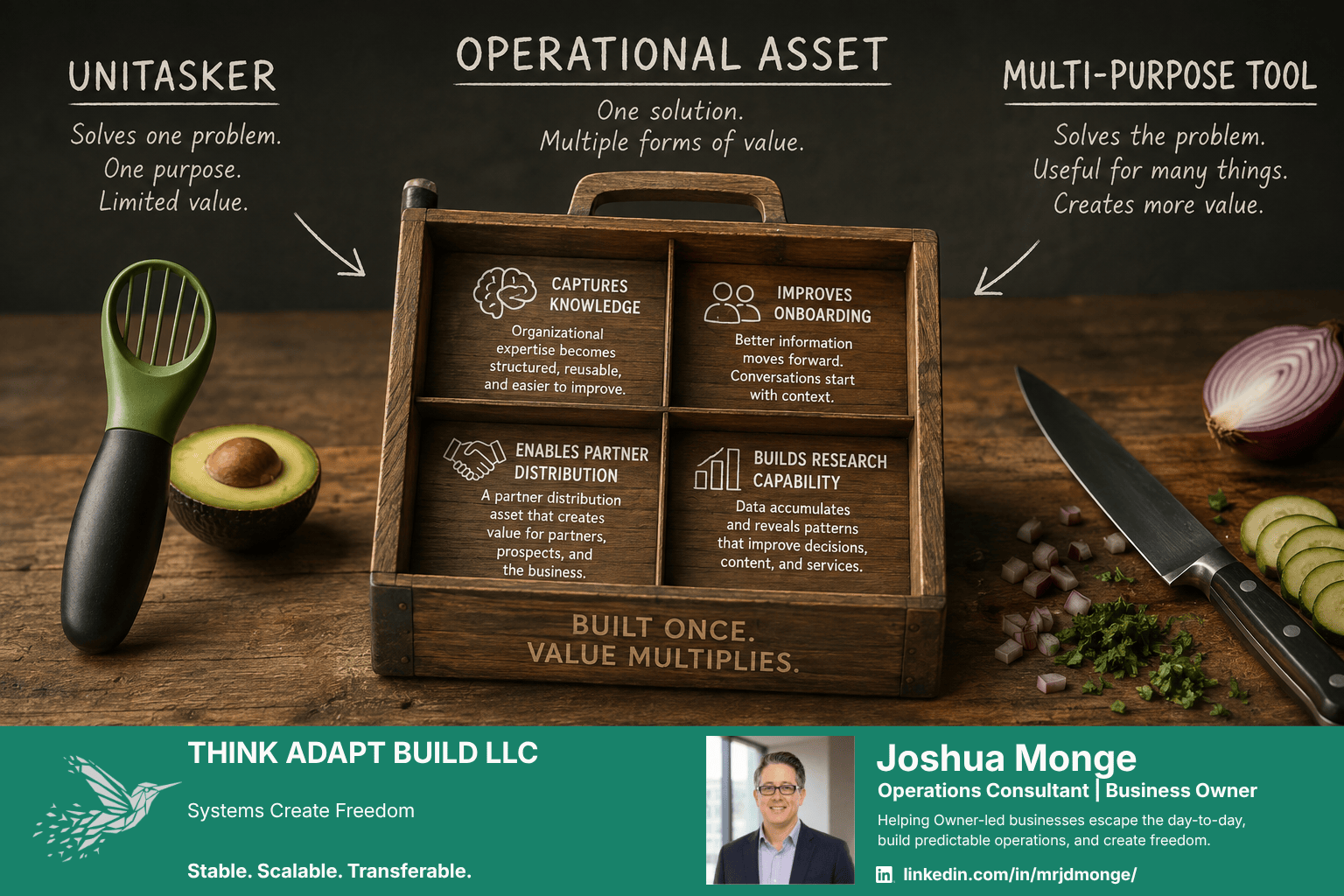
Alton Brown has a philosophy about kitchen tools that I’ve always liked: avoid unitaskers.
The basic idea is that most tools in your kitchen should be useful for more than one thing. You can buy a specialized tool designed to scoop an avocado, or you can learn to use a paring knife that handles the avocado just fine and is useful for hundreds of other jobs.
That doesn’t mean specialized tools are always bad. If you run a restaurant and process 500 avocados a day, the economics may justify something purpose-built. Context matters.
But the principle is useful well beyond a kitchen.
I think businesses accumulate unitaskers too.
A problem appears, we solve that specific problem, and we move on. Another problem appears, we build another solution. Each decision makes sense on its own, but over time the business ends up carrying a collection of processes, spreadsheets, software, automations, and workarounds that each do one thing.
Sometimes that’s exactly what is needed. But when a recurring problem is important enough to justify a real investment, I think there is a better question to ask:
Can we solve this problem in a way that builds an asset for the business?
The Problem We Were Solving
I recently worked on an assessment system for a client as part of a lead-generation process.
We wanted someone to be able to complete an assessment and receive a customized report based on their answers. The goal wasn’t just to collect someone’s information. We wanted to provide something genuinely useful before an engagement ever started.
We already had a way to do it.
A person could review the assessment responses, work with AI to develop the appropriate responses and recommendations, make adjustments, and assemble the final report.
It worked, but there was friction. Every report required manual involvement, and we were seeing drift in the output. Similar inputs didn’t always result in similar outputs because the process still depended heavily on how someone interacted with AI each time.
The narrow solution was pretty obvious: automate report generation.
We could have built something that took the answers, produced the report faster and more consistently, and stopped there. That would have solved the immediate operational problem.
But it also would have been a unitasker.
If we were going to invest in solving this recurring problem, there was an opportunity to build something the business could keep getting value from.
When the problem is recurring and the investment is justified, the best operational solutions can build assets the business gets to keep.
Designing the Solution as an Operational Asset
Once we decided the process was worth rebuilding, we looked beyond report creation at what was actually moving through the system.
There was expertise. There was customer information. There were calculations and decision rules. There were potential partner relationships. There was information we would need later if someone became a customer. And over time, there would be a growing collection of structured responses from the market.
That changed how we designed the solution.
The system still needed to do the original job well. Someone can complete the assessment, the appropriate logic and calculations are applied, and a customized report can be produced in minutes with much greater consistency.
But the solution we built is a multifaceted operational asset. In addition to solving the original problem:
- It captures organizational knowledge. The client’s logic, known responses, calculations, and expertise no longer have to be recreated through a person working with AI every time. That knowledge becomes structured, reusable, and easier to improve.
- It improves the path into onboarding. Relevant information collected during the assessment can move into the CRM. Future conversations start with context, and if someone becomes a customer, portions of discovery and onboarding have already happened.
- It creates a partner distribution asset. The assessment can be white-labeled so partner organizations can offer it to their own audiences. The partner gets something useful to provide, the person taking it receives real value, and the client gains another path to potential customers.
- It creates the foundation for proprietary research. As assessments accumulate, appropriately aggregated responses can begin showing patterns across the market. That information can eventually improve the assessment, services, content, sales conversations, and business decisions.
Those aren’t four separate solutions we bolted together after automating the report.
They’re different facets of the same operational asset.
One Investment, Multiple Forms of Return
If we evaluated this project only against the original friction, the ROI calculation would be fairly simple. How long did a report take before? How long does it take now? Multiply the difference by the number of reports and the cost of the person producing them.
That’s real value. Time reclaimed matters.
But it would significantly understate the return because we’d be measuring the solution only against the original problem.
The same investment now improves consistency in report delivery, captures organizational knowledge, gives future sales conversations better information, reduces onboarding work, creates something partners can distribute, and builds the foundation for proprietary research.
That is what I mean by building assets through operational solutions.
The goal isn’t to take every operational problem and turn it into some giant interconnected system. That creates its own Operational Debt. Complexity has a carrying cost, and sometimes the simple fix is absolutely the right answer.
The opportunity is to understand the work surrounding the problem before deciding what the solution should be.
What information is already passing through the process? Where will it be needed next? What knowledge are people repeatedly applying? What happens immediately before and after this work? Who else could benefit from the capability we’re creating? Is the process generating information that becomes more valuable over time?
Those questions can reveal opportunities to get significantly more from the same investment without creating five different solutions.
Businesses Have Unitaskers Too
This is where I think the kitchen analogy holds up.
A paring knife earns its place because it solves the problem in front of you without limiting its usefulness to that one problem.
Good operational assets can work the same way.
A customer intake process can also improve onboarding. A reporting system can also capture institutional knowledge. A training process can also create documentation. A customer-facing tool can also become something referral partners distribute. Information collected to perform one service can also improve future decisions.
The point isn’t to force every solution to do five jobs. Sometimes the avocado scoop is exactly what you need. A tool that does one important job exceptionally well can absolutely earn its place.
The point is to notice when you’re about to make a meaningful investment in solving a recurring problem and ask whether you’re designing around the immediate task or around the larger capability the business needs.
That difference matters as a company grows because every solution has a carrying cost. Someone has to maintain it, understand it, train people on it, pay for it, connect it to everything else, and eventually replace it.
As these single-purpose solutions accumulate, someone eventually has to understand how they all fit together. In founder-led businesses, that job has a habit of finding its way back to the founder.
If we’re going to take on the carrying cost of a new solution, I’d rather build something that creates value beyond the immediate problem whenever the opportunity is there.
Pay Attention to the Friction
There will always be quick fixes and narrow solutions in a business. There should be. Trying to turn every operational improvement into an asset would slow the company down and create unnecessary complexity.
But recurring friction is worth paying attention to.
The report someone hates rebuilding every week. The information customers keep getting asked for. The spreadsheet everyone works around. The decision that always finds its way back to the owner. The employee who has developed their own process because the official one doesn’t really work.
That friction is telling you something.
It may be pointing to information that isn’t flowing, knowledge that hasn’t been captured, a process that no longer fits the business, or capability that hasn’t kept pace with growth. Sometimes it’s a minor annoyance worth living with. Other times it’s the symptom of something the business has been paying for over and over again without realizing it.
That’s what happened with this assessment system. The immediate friction was the time and inconsistency involved in manually creating customized reports with AI. We could have solved only that problem. Instead, looking at the larger process helped us design a multifaceted operational asset that captures organizational knowledge, improves the path into onboarding, creates a partner distribution asset, and builds the foundation for proprietary research.
That’s what I mean by building assets through operational solutions.
You don’t need to go looking for complicated problems to find opportunities like this. Start with the friction people are already feeling. Pay attention to the workarounds they’ve created, the things they complain about, the work they keep repeating, and the places where someone says, “That’s just how we do it.”
Then investigate what that friction is actually telling you.
Sometimes you’ll find a problem that just needs to be fixed.
Other times, you’ll find an opportunity to solve the problem by building an operational asset the business gets to keep.

A seasoned professional with over 20 + years of professional experience. From Fortune 500 companies to small businesses, from the factory floor to the C-Suite, Joshua has worked with people from all walks of life. His goal is to help business owners get the solutions they need.